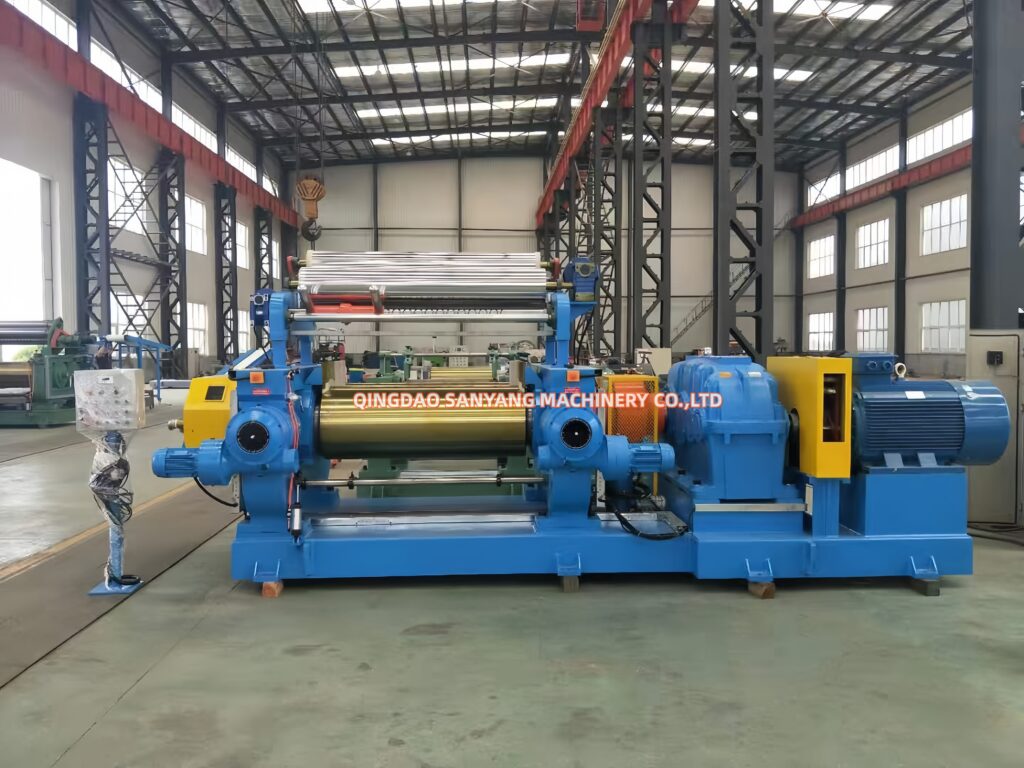
Two roll mixing mill, also known as an open rubber mill, is one of the most essential rubber processing machines in the rubber and plastics industry. It is widely used for rubber mastication, rubber compounding and plastic mixing. The open two roll mixing mill remains popular in factory production, laboratory testing and small-batch material processing.
1. Basic Structure of Open Mixing Mill
The typical open mixing mill consists of two parallel horizontal rollers that rotate at different speeds. According to the driving system, it is divided into single-drive and dual-drive models. The dual-drive open two roll mill offers higher torque and more stable rotation, However, the dual-drive model is relatively expensive.The single-drive form, due to its lower price, is more widely used in the market.
The gap between the two rollers can be precisely adjusted with a digital display system, which helps operators control material thickness and ensure consistent processing quality. Most industrial open mills are equipped with safety protective covers, stable transmission devices and optional automatic rubber turning systems to improve production efficiency and operational safety.
2. Working Principle of Open Mixing Mill
The working principle of an open two roll mixing mill relies on speed difference between the two rollers to generate strong shear, extrusion and stretching force. When raw rubber, synthetic rubber and chemical additives pass through the roller gap, the mechanical force breaks rubber molecular chains, disperses fillers and curing agents evenly, and achieves full material homogenization.
During continuous operation, repeated folding and rolling eliminates material agglomeration, ensures uniform mixing and improves rubber plasticity. Advanced open mill models support automatic material turning, which greatly reduces manual work and avoids inconsistent mixing results.
3. Advantages of Open Two Roll Mixing Mill
Compared with internal mixers and other closed mixing equipment, the open mill has unique advantages for industrial and experimental use:
- Simple mechanical structure with low failure rate and easy daily maintenance
- Visible working process, allowing real-time observation and parameter adjustment
- High flexibility for various materials and batch production demands
- Lower investment cost and stable long-term operation performance
4. Daily Maintenance and Safety Operation
Reasonable maintenance can effectively extend the service life of the open two roll mill and keep high processing accuracy. Standard maintenance and safety tips are as follows:
- Regularly inspect roller surfaces, bearings and transmission gears to avoid abnormal wear and noise
- Clean residual rubber materials and lubricate transmission parts periodically
- Calibrate the roller gap frequently to ensure consistent mixing thickness
- Operate strictly in accordance with safety regulations to prevent clamping and mechanical injuries
5. Conclusion
The open two roll mixing mill is irreplaceable in rubber pretreatment and material mixing processes. With flexible operation, stable performance and wide material compatibility, it meets the production needs of mass manufacturing, customized processing and laboratory formula development. Scientific daily maintenance and standardized operation can maximize machine efficiency and reduce long-term production costs.